Thursday, June 25, 2015

The Fifth Sunday after Pentecost                                               
Proper 8 - Year B
2 Corinthians 8:7-15


Paul writes the Corinthian congregation about their involvement with the wider church - in particular the current fundraising project which the outlying churches have undertaken to support the mother Church in Jerusalem. 

"For if the eagerness is there, the gift is acceptable according to what one has—not according to what one does not have."

If-then statements are meant to show how things are tied together.  If you have snow tires then you'll make it to the top of the snowy hill.  If you have a full tank of gas then you will get to Swift Current without gazing nervously at the gas gauge.  If you have the right qualifications then your job application will be received and reviewed.  If-then statements also serve to to provoke self-reflection.  Do you, in fact, have snow tires?  Did you tank up in Saskatoon?  Did you pass your Statistics course at University?  No?  Tough darts then.

Petrol, snow tires and school transcripts are easily quantified.  You have them or you don't.  You can tick the box or not.  Eagerness (and the Greek word here can be translated as zeal, readiness, energy, inclination) is less concrete but completely essential to the task. What Paul seems to be saying here is that it's not just a matter of getting the Quartermaster to do an inventory of what concrete resources
you have at hand but of asking yourself (or your community or your committee)  whether or not you (or they) are interested in doing anything at all.  Do you have that essential ingredient - the presence of which will forgive any number of shortages in concrete resources - which is the good will, the energy, the decision, the inclination and the openness of heart necessary to plug you in to the world around you and to seek after God’s Kingdom?  Yes?  No?

Without mentioning the specific teachings of Jesus anywhere in his Epistles, Paul has all the parables on his side.  The parables are chock full of under-equipped and under-resourced individuals who nonetheless have the following quality:  When they are invited to the banquet they say yes.  When they encounter the treasure in a field they will do what is necessary to make sure it becomes theirs.  They may have nothing but their hunger for righteousness, their inclination towards others, their desire to find meaning in their lives, their willingness to build community and to treasure those bonds with others.  But it's there, that spark.  They can identify it.  They can set their priorities by it.   And if, one day, that energy began to flag then they would themselves know it before anyone took them to task.

“Yes - you're right - I've been a little off recently.”

Do you have what it takes to move forward when energy, conviction and and determination are more important than concrete resources?   If not - then what are you going to do about that?  How can we help?


Thursday, June 18, 2015

The Fourth Sunday after Pentecost
Proper 7 - Year B
Mark 4:35-41


The disciples cry out to Jesus, asleep in the boat in the midst of a furious storm

"...do you not care that we are perishing"?

These are words echoed by men and women in various degrees of necessity across the years. Sometimes they are to blame for their sufferings. They've gotten themselves into trouble because of stupidity, dishonesty or self-deception. Or they find themselves, quite innocently, at the mercy of somebody else. An enemy threatens them. Or perhaps, again, there is no ill will at all.  Nothing is askew in anybody's humanity. The wind has simply picked up and the water laps into the boat. Things fall over, the thunder booms and the lightning flashes: The wrong place at the wrong time.

Aren't we owed some safety and security? Don't we have an "in" with God? How can Jesus possibly be sleeping in the boat while the storm rages around his followers? I make no attempt to answer the age-old question in 500 words except to point you to an interesting verb in this passage from Mark: Jesus tells the storm to be silent. He does not say "Be still" or "Be calm" or "Flatten yourself". He tells the storm, literally, to shut up (perfect passive imperative tense - "be muzzled and remain so") and employs the same verb he will later use when he tells the demons to be silent - that they have no right to tell anybody's story - least of all his.

What does a disaster or the threat of a disaster tell us in words? Can the activity of impersonal forces - water, fire, rain or earthquake, dividing cells or economic downturn - be said to have a voice of some sort that might prompt the rebuke to be silent and remain so? 

It might well. We feel guilty when bad things happen to us - even when they are outwith our control. We walk away from the downsized office with our desk's contents in a cardboard box feeling like failures because our job has been moved overseas. We take our inability to protect a loved one from what could not possibly be foreseen as a personal failure. We do it all the time. We are at fault. God is at fault. It cannot simply be something which happens - it has to be a story about my failure and unworthiness or God's failure and unworthiness.

More, the disaster says to us, you are alone - all alone here in your boat.

Jesus says "shut up" as much to the disciples as to the storm. We are not alone. In his Incarnation, Jesus comes to join us and not to leave us. The words which course through the disciples' heads - words about abandonment, loneliness and the inadequacy of both man and God are a lie - worthy of being muzzled and remaining so. In this world, where we will continue to be subject to our own weakness, to the wiles of others and to the power of lake water at 2204 pounds per cubic meter of wave, faith can and must and will be found. Jesus is there with us on that shifting ground and there his Kingdom can be discovered.


Saturday, June 13, 2015

The Third Sunday after Pentecost
Proper 6 - Year B
1 Samuel 15:34-16:13

Israel had to argue for its right to be ruled by a king like all the other nations. "Don't confuse yourself with other nations" says God, through the prophet Samuel.  "You are different. A king will not make you great or a major player or a big fish. You are unique - ruled as you are by judges and informed by prophets"

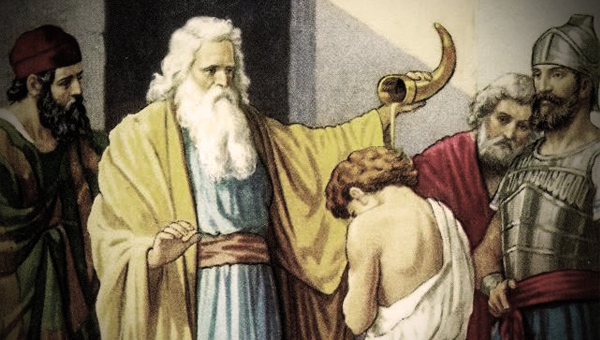
Nonetheless Israel's desire to be like all the other nations prevails. God relents and lets them have their king. The Reign of Saul is Israel's first stab at being completely ordinary and it is a resounding failure. Saul is rejected by God and his fate is sealed. Samuel is instructed to anoint a new king from

among the sons of Jesse. He arrives at Jesse's house. The boys are led in one at a time from the greatest to the least. Good strong boys they are, too. Each time Samuel the prophet sees one of them he is reassured that they have King written all over them. And each time God tells the prophet "No, not this one."

He finally has to ask if there are other boys that he hasn't met and Jesse admits that the youngest has been left off the list. He's been sent out to take care of the flocks while his brothers are being admired for their natural aptitudes - their ease of speech - their leadership potential. These were the boys fit to be presented to a prophet. Not the youngest. He was left off the list. David is sent for and Samuel anoints him as King.

The adjectives "big" and "little" are some of the first things we learn. We're told to think big, we can hardly wait to be big. We are attracted to big ideas, big houses, big cars and big ambitions and we will need to deal with the fact that we miss out rather a lot because of that obsession. That's the way of the world - that's the way the world thinks. We too are a unique people and we give up that uniqueness all too quickly. Our history of faith, contained in the salvation history covering the two Testaments of the Bible, is filled with stories of world changing events taking place in out-of-the-way locations and with quite ordinary people initiating those events at the behest of God's voice. The stone which the builders rejected becomes the capstone of the arch. Tiny mustard seeds grow into great and commodious plants within the garden - in whose branches the birds of the air can make their nests. Suffering becomes victory. Weakness proves to be strength.

The ordinary logic of the world does not explain what happens in the life of faith.

Think again. "Big" and "little" just don't cover it


Friday, June 05, 2015

The Second Sunday after Pentecost
Proper 5 - Year B
2 Corinthians 4:13-15:1

When you're threatened enough you'll look around for something heavy or pointy enough to throw overhand at whatever opponent stands in your path. If you receive a large and unexpected bill in the post you'll dig out the bank statements to see what sort of liquid resources you have to pay your way out of trouble. You put your trust in the Bank of England, or in the reliability of a good diesel engine or maybe in Smith & Wesson. Please insert here whichever tool or resource you choose which you believe will ensure that you make it to the next point in your journey. You are strong and able. You can list the resources you have at hand to keep yourself on the top step. It may be a long list.

Anytime we generalize about the state of human beings around the world or across time and use a term like, say, "the human condition" we are usually referring to where humans find themselves when their strength runs out and when their natural goodness reaches its limit. Even calling it "the human condition" pretty well lets the secret out, doesn't it? We are not really that strong. If we are strong we tend to be strong for a season only. There is something illusory or at least temporary about the visible tools and structures with which we ensure our future.

You can't take it with you, we say.

Saint Paul wants the members of the Church in Corinth (or in Clermont-Ferrand) to look beyond what they can see and touch and to find the ground of their confidence in what God is building, invisibly, in and among and around them.

"...we look not at what can be seen
but at what cannot be seen;
for what can be seen is temporary,
but what cannot be seen is eternal.."

Paul is not writing to impractical people. He is writing to a mixed community of urban Christians - many of whom are well-equipped with earthly resources - and he is telling them that the building blocks of faith, hope, love and perseverance will build them a home. Their worship will create a
world. What the skeptic might deny has, for them, the greatest and the most enduring reality. God is making them a home which surpasses any ability they may have to fend for themselves. The strong and the well equipped are not as safe as they think they are. The weak may well not be so weak.

Learn this. Teach it to your children. Let it be a part of your discourse as Christians. It is nothing other than what Jesus taught us in the Parables of the Kingdom - that God provisions his people in ways that the world neither sees nor understands.  The smallest seeds can become the greatest shrubs in the garden.


Thursday, May 28, 2015

Trinity Sunday - Year B
John 3:1-17

Talk of the Trinity might take you back to your Confirmation Class.   You believed yourself to be quite clever then. Between fidgeting you may have asked what you thought were clever questions.   Eventually your parish priest leaned forward and said to you: "Now then.  That's just the way things are, okay?".  Over the years, Trinitarian language has often been more assented to than understood. In terms of solving mysteries the language of the Creeds might tend, rather, to deepen them.   At the Council of Nicaea, where we get the Nicene Creed we recite every Sunday, the stakes were particularly high.  It took an Emperor - in this case, Constantine himself - to lean forward, armed with the opinion of the majority and say to the dissenters: "Now then.  That's just the way things are, okay?"


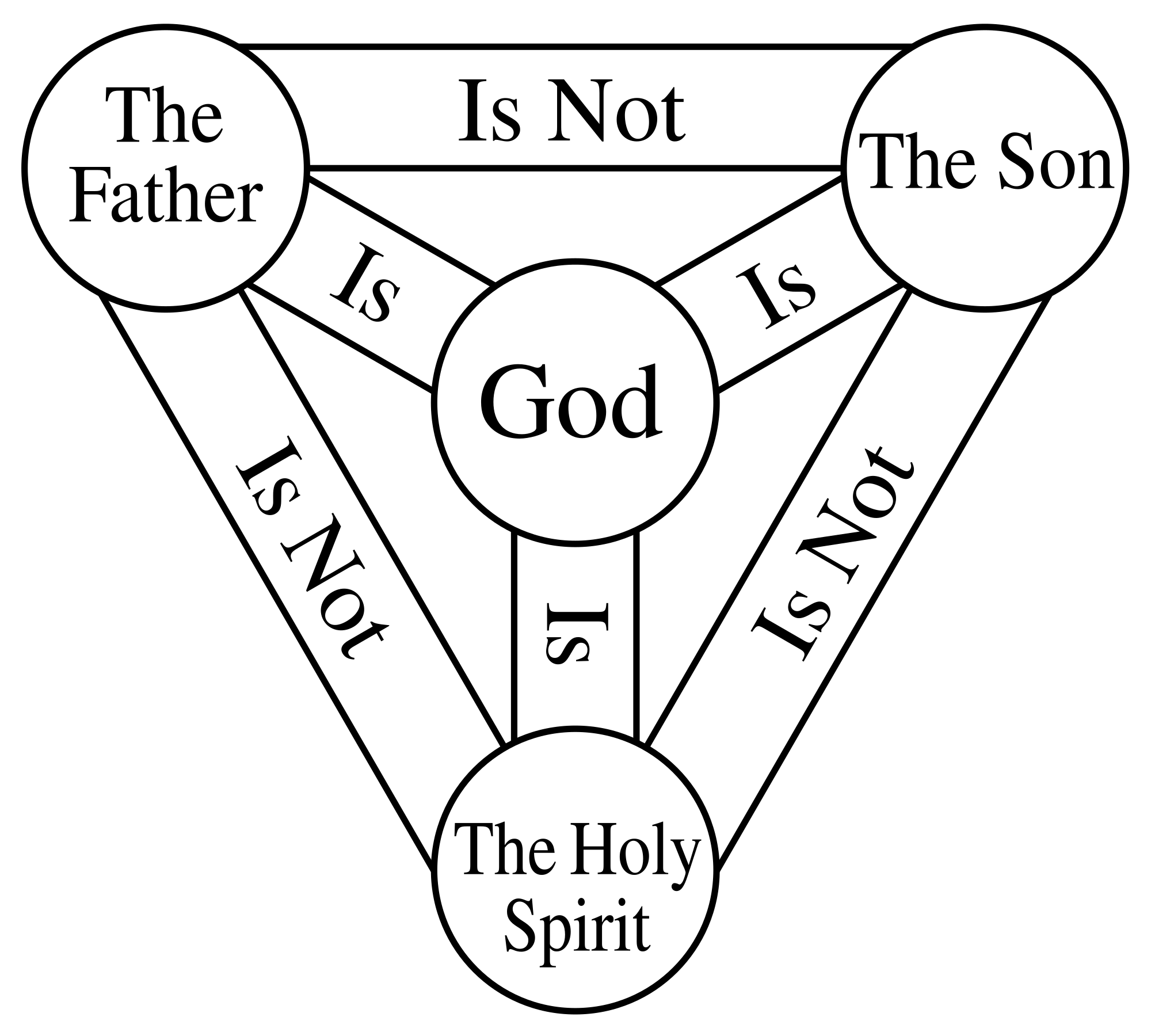
The Trinity of God (that God is, at the same time, Father, Son and Holy Spirit) is often demonstrated with the use of diagrams and little maps. You might be forgiven for thinking that God can be learned - that once you've got this diagram in your head you've understood God - that you've "got it".  Which is a pity because the idea of the Trinity leads us to know of God that his relationship with the world is dynamic, colourful and full of novelty and movement.  The choice of Gospel readings for Trinity Sunday - Jesus' conversation with Nicodemus - takes us in an exactly opposite direction to the belief that we could ever capture God in a diagram.  No, Nicodemus, you don't get God - you don't draw a circle around him, he's not your possession or something which you claim in the name of your tribe.  We are not proprietors of God's Spirit.  Instead, we are the ones who follow the movement of that same Spirit. 

If anything God gets us.


Thursday, May 21, 2015

Pentecost Sunday - Year B
John 15:26-27; 16:4b-15     

There’s a case to be made.  Jesus refers to the Holy Spirit - whom he will send once he has ascended to his Father in heaven - as the Advocate.  It’s one translation of the Greek word Paraclete and within the reading from John’s Gospel on this Pentecost Sunday is the one that seems to make the most sense.  There is a case to be made - and a world to be “brought around” and convinced of the truth of God revealed in Jesus.  This work, it seems, will need to be carried on even amongst the saints of God and even among the disciples gathered with Jesus in the upper room doing this long discourse which we have been reading now for several Sundays.  Paraclete is sometimes translated “Comforter” or “Encourager” because the work of the Spirit of God is going on amongst us as well.  Today’s reading follows closely Jesus’ earnest plea to his disciples to remain attached to him - as closely as branches are attached to the vine.   One can become cut off and isolated.  It seems that we too are at risk of straying away.  There is a case to be made - even to us.

Do you sense it?  You have struggled with that yawning sense that there were other choices for you to make and that you have strayed from where you know you needed to be.  You read about Christ’s people being called “from” the world to a new life with all its fullness. You may look around and find that the life you’re leading right now is a pretty predictable biological progression from childhood to youth to adulthood and eventual senescence.  It was not to be that way.  How did it happen?

While all this matters very much - this state of affairs which could provoke uncertainty, tears or regret - I want you to concentrate on what Jesus is promising us in these chapters of John’s Gospel.  What Jesus promises the world and his servants in the world who find themselves at risk, is that he will not leave them alone.  The story is not over for the sheep who is lost.  It is not Christ’s will that we find ourselves shipwrecked, sidetracked, handed over to our own appetites, lost, frustrated or misled.  “I will not leave you as orphans” Jesus said to us (John 14:18).  Will he bring to mind what is painfully amiss?    Of course.  The language is one of struggle as our will and our priorities come into focus.  Be encouraged.  Be comforted.  Above all, be seized by Christ’s words and listen!   The advocate is speaking.  There is a case to be made!


Wednesday, May 13, 2015

Easter 7 - Year B
John 15:9-17

“'When I use a word,’ Humpty Dumpty said in rather a scornful tone, ‘it means just what I choose it to mean — neither more nor less'."

Words can mean different things when we use them in different contexts.  We love caramel, we love our national anthem, we love our dog Rex, we love the way our small children mispronounce words, we know our parents love us even when we're in a pinch and we find ourselves reassured by the promise of God's love demonstrated and expressed in the Cross of Christ.  Each one of these uses differs from the other.  Some are shown to be real because we sense a sentiment within ourselves which may or may not pass quickly when we grow out of loving something.  Our children grow into surly teenagers. We wish they'd learn to pronounce things properly if they hope to get through a job interview.

The Greek language has different words for love - more than we do in English.  They avoid some of the ambiguity and confusion by having different words for erotic love, love between friends, simple affection and the self-giving love which is Agape.  C.S. Lewis in his book "The Four Loves" describes these different definitions along a line stretching from "need love" at one end of the spectrum to "gift love" on the other.  Love can feed and build up the lover or it can feed and build up the beloved.  Which one is which is important to the children we raise, the man or woman we are married to, the community we serve or to the world which waits for the Church's offering of care and compassion.  Do they serve us or do we serve them?  Confusion here can be dreadful.  The vocation of a parish church within its community can be lost, the fabric of a marriage torn apart or children poorly served by parents when the beloved discovers that he or she was poorly loved and the lover simply replies that he or she could not generate enough feeling or sentiment within themselves.

We learn to love.   We have not all been equally loved in the course of our lives.  Some of us will need to unlearn early experiences.  How we love in our adolescence or early adulthood will be tested and reformulated as we grow older.  Love is tested by the trials of life and above all by the need to make decisions.  The difficult person, the growing child, the normal human to whom we are married, the members of the Christian community into whose presence we have been thrown by our membership in the same parish: all these will require decisions and actions which stem from our will and not merely from the reservoir of sentiment we happen to have at hand at any given moment.  Those around us will grow strong when we choose to love.


Saturday, May 02, 2015

Easter 3 - Year B
Luke 24:13-35

Luke describes events on the road to Emmaus, near Jerusalem, where Jesus broke bread in the midst of two disciples and opened their minds by his exposition of the Scriptures. The downcast disciples were heartened by the encounter and went on their way much improved. A clergy-person might feel tempted to own this scripture passage.

Word and Sacrament? In the space of an hour or so? It's about us, innit?

Don't we strive to be this sort of "point on the journey" for our parishioners? Wouldn't it be great if, on next year's Annual Parochial Return, I was able to report that most our our membership had gone from "Wandering Uncertainty and Deep Perplexity" (line 6) to "Blessed Assurance, Expectation and Commitment to Living the Resurrection Life" (line 8)? Alas, I do not think Saint Luke is plotting out the shape of a perfect church service or a parish's program year. Yet there is an important point to glean herein.

Jesus is inordinately interested in what the disciples are already talking about. 
He asks them about it.: 


"What are you discussing with each other while you walk along?" 

He is more interested in them than we are, oftentimes, in our own people. Where did we develop the bad habit of treating the visitor, the new member or the "passer-through" as a bank slate - a tabula rasa, if you will - upon which we impose the indisputable goodness of the creeds, the Mass, John 3:16, the happy life of our parish, bells, hymns, incense or the compelling brown eyes of the Rector?

A shining light of revelation which dismisses human concerns, hopes, griefs, joys, errors and aspirations and takes them off the table with one sweep of the arm is a truly limited affair in the Bible. You don't find much of that. Most of the encounters God has with people are genuine conversations. We already know that the years of struggle or inner turmoil which precede our own healthy forward steps are not negated when we do, in fact, step forward. They are a part of the process. We may be better off afterwards but we are still the struggling person God met when he or she was still struggling.

He reasoned with us over time. He met us on the road. This is evidence of love and it made the next part possible. 


Friday, May 01, 2015

Easter 5 - Year B
John 15:1-8


Back in the day my father nicked the branch of a grapevine with a scythe.  Though it was early in the season, with no grapes and only the earliest indication of leaves, the vine wept copiously for weeks even though he tried to bind the wound with a tight dressing.  Off-season grape vines look like little more than dry sticks and yet the vine sends vital nourishment out to those buds with tremendous intention.  Appearances are deceiving.  The nourishment goes on subtly and quietly but the leaves and the fruit do take form.  They provide a harvest for the vintner and shade for his family in the heat of the day.

Jesus tells his disciples that he is the true vine and that they are branches.  His father is the cultivator, the one who keeps the branches pruned back and effective.  They can do nothing apart from the vine.   Life will not be fruitful and ministry ineffective.  There will be no joy - not for Jesus and not for the disciples - unless they remain connected to the source of their life.

Finding a secret source of strength might be enticing.  You could write a book about it.  People might buy it.  There's gold in those hills.   There's pirate treasure in the bay. There's oil underneath Jed Clampett's land - black gold, Texas Tea, resources and power.  Our devices will work if we plug them in - if (as per the French verb) we are branché - connected and plugged in.

But to what end do we seek to be so plugged in?  Is this mostly about us?  Is it our well-being which is the subject at hand?  After all, resources  can be sucked up, used up, squandered, rejoiced in and they could in theory end with us.  No - Jesus' words make references to the fruitfulness of branches, hanging heavy with fruit because the disciples are to become lovers of others, conduits for God's grace to the world around them.  That's what the subject heading is for this whole long discourse running from John 13 to the end of chapter 17:  "...even as I have loved you, that you also love one another."  Jesus takes it for granted that the disciples desire is to remain connected with the work of the Kingdom, to feed the world around them and to extend God's friendship into it.

Are our vines weeping?  Did they get nicked when we drew a circle around our resources even if we did this for what seemed like the best of all reasons - care of self and care of our loved ones?  We are survivors - no question.  Are we disciples?  If so then we are necessarily connected to a world - a world which groans for our fellowship and which has been promised the harvest from our branches.

"By this my Father is glorified, that you bear much fruit, and prove to be my disciples."


Thursday, April 23, 2015

Easter 4 - Year B
John 10:11-18                                                                          


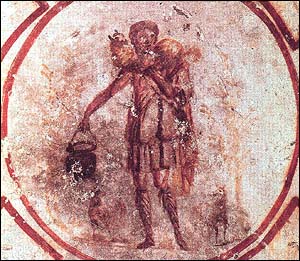
One of the early Christian symbols you'll find painted or scratched onto the walls of early basilicas or Christian burial sites is that of a man with a sheep draped over his shoulders.   In the world of early Christianity the image of the Good Shepherd is most common in the years prior to the Edict of Milan, before the faithful could openly identify as Christians and practice their faith publicly. It was a time of worry when the sword of local or Empire-wide persecution might drop at any time.  Jesus' words to his disciples in John 10, where he describes himself as the Good Shepherd who will never abandon his sheep, had a particular poignancy during these years.

Worry is a relative thing.  A few of us should worry more.  Many of us worry far too much.  We worry about things which are theoretically possible but will never happen.  We worry about things which worry itself will not change.  We worry about things which can be fixed but worrying does not, in and of itself, provide us with the means or motivation to make those changes.  Anxiety becomes a free-floating state of mind - a way of life rather than a tool to keep us safe.  Useless and wasteful, it shortens our lives and robs the world of its colour.

But I know Whom I have believèd,
And am persuaded that He is able
To keep that which I’ve committed
Unto Him against that day

Do you believe that we have a Saviour, an Advocate and a Shepherd?  We say the words and we sing the hymns (the above is from 2 Timothy 1:12).  In the best of all possible worlds those words would sink down into our souls and condition our response to both real and imaginary threats.  What is in the way?  Perhaps we were taught to fear by others and are carrying the baton in our generation which our parents passed to us.  Perhaps we were improperly shepherded  or nurtured by grownups when we were small and learned to fear anything in the world which was beyond our immediate control.  Discovering whose voice it is which we hear on the tape-loop in our heads when we fret is something which might well repay the effort.

Jesus does not tell us that the world will always be a safe place.  He does tell us however that he knows us.  And that we can know him.  This is somehow enough.  The strength of that loving bond will be sufficient to sustain us in good times and in bad.  The gift of God to the world was, is and remains the Person of Christ in whom there is nurture, protection and ultimate safety.  Be persuaded of that love.  Invest - actively and intentionally - in that relationship.


Thursday, February 26, 2015

Lent 2 - Year B
Romans 4:13-25

Paul begins the 4th chapter of Romans by asking "What then shall we say about Abraham, our forefather according to the flesh?"  The answer, it appears, is rather a lot - all of Romans 4, in fact, and the entire 3rd chapter of his Epistle to the Galatians.  God who addressed Abraham back in Genesis 12-17 is one who, still today, "gives life to the dead and calls into existence the things that do not exist."  These words, says Paul, were written for us as well and not only to illustrate something which happened long ago.  They bear on the current life of Christians in Rome, in Croix de Neyrat and Chamalières.  They tell us how to be faithful in this church of ours - in this skin of mine.  

A brutally literal translation of Romans 4:18 would say, of Abraham, that he

against hope
in hope
believed.....

which, while ugly English, at least has the benefit of emphasizing the two different ropes which we hold on to.  One is our own self-sufficiency.  It is admittedly quite a frayed thing.  Our character is flawed and sinful.  Our neurons are no longer fit for purpose.  We are too old.  We are young and stupid. The opportunity has fled elsewhere.  The judgement is against us. Our pipeline is vetoed.  That rope - whatever it was - will not support our weight.  We only delude ourselves by hoping that its fragmentary fibers will do what, we know full well, they will not do.  Part of the process is to let that fact sink in - definitively.  That first rope is hopeless.  It will not hold us up. 

So why not switch ropes?  God never showed Abraham a mirror in order to encourage him that, if he eats all his veg, he might locate a bit of life left in that old frame of his - one more lap around the track, if you like. God pointed Abraham beyond himself - to the innumerable stars in the sky and the grains of sand on the beach.  "So shall your descendants be", says God.  I will make it so.  And "Abraham believed God".  The second rope.

Many young clergy imagine that their job is to tell people to keep their chins up and that things are probably not that bad.  "Hoping against hope" (NRSV!) is too often understood as an exercise in optimism - redeeming that one useless rope in the face of all evidence.   Instead of the power of God made accessible to those who believe we ape the motivational speakers and embark on some project about the power of positive thinking. 


And that's not it - not it at all.  It's a whole 'nuther rope.


Prospect  
Matthew 17:1-9  

Squint and you won't look so fat in the mirror.   Take your specs off and you could obscure your vision still further.  The world might look even better.  Or follow the old platitude and take a second gander at your familiar cloud.  Find its silver lining.  Force yourself.  Deep down, though, you know that it's a normal exercise in self-deception.  We do it all the time.  We're working hard to cover up reality.   We hide much.  We reveal nothing.

In this Sunday's Gospel reading, Jesus takes Peter, James and John with him to a high mountain (the story appears in all first three Gospels).  In their presence Jesus is "transfigured".   Matthew and Mark use the passive verb "was metamorphosed" while Luke chooses to describe the process thus: "...the fashion of his countenance was altered".  Jesus shines.  His clothing becomes bright.  Two characters from Israel's history - Moses and Elijah - suddenly appear at his side.  A voice speaks from heaven. The disciples are afraid and do not understand.  They babble or, at least, Peter babbles.  

 Recognizing that the disciples do not have the words to describe what they have seen, Jesus tells them to keep their mouths shut:  "Tell no one about the vision until after the Son of Man has been raised from the dead".

Unlike the normal impulse to prettify a shabby situation, this vision strikes the disciples out of the blue.  It is one which I believe has been better painted by artists, over the years, than it has been retold by preachers.  It is what it is: a hint or a first installment of something that is to come. For the three disciples it is precisely what they will know and preach with clarity after Easter.   It is what St Paul will one day write about to his congregations.  For Peter, James and John that day, God opens the door just a crack.  They catch a glimpse of the full picture: Jesus the light to the world who unites the present (and future) world of his followers with the mighty and saving acts of God in the history of Israel.  

Willful self-deception closes a door.
Unbidden mystery forces it open.

"This is my Son", God says, "Listen to him!"  


Friday, February 20, 2015

Lent 1 - Year B
Mark 1:9-15

One man's desert is another man's paradise.  Is it a testimony to human ingenuity that the "empty real estate" of the Negev, or the deserts of the American west are turned into the sort of places where Iceberg Lettuce can be successfully grown?  Look what we've done: We've made the desert bloom!  You might risk war with your neighbors in the Middle East over the ownership of the water resources necessary to do this.  The subterranean aquifers deep beneath your country might be at risk of running down sooner rather  than later but, yes, it can be done if you believe that all deserts are empty and unproductive places without evidence of green things growing in tidy rows.

Deserts are irrigated, then.  Wetlands are drained.   Only as an afterthought do we realize that what we regarded as useless, empty and even hostile environments were filled with life and hosted complex and interdependent systems of creaturely existence.  Such places set the minds of poets, monks and scientists aflame.  They represented that part of the world which was not completely under the control of commerce and agriculture and was, therefore the source of much novelty, mystery and possibility.  It is no longer taken for granted that we can transform a desert or wetlands into a profitable piece of ground.  In most places of the world we now require permission and our business plan will meet with resistance.

That Jesus spends time in a wilderness at the beginning of his ministry is no accident.  Israel has always come to its senses in the desert - in a place where the din of human conversation is silenced and where the usual comforts are set aside.  The desert is a place where humans are sheltered by whatever structures God had made and not by the labour of their own masons and carpenters.  It is a place where food is found and not grown.  It is a place where priorities are reassessed and new decisions are made.  Do you have such a place around you?  Do you have such a place within you?  At the end of your lives, or even now, you might well identify a stretch of time when things were taken from you - some traumatic episode in your life when change was forced upon you by a tweak in your circumstances. 

At the time it was no fun at all.  You would have welcomed a friendly enterprise with bulldozers or drilling equipment.  Let us fill in those low bits for you, let us drill a well so that we can provide your  habitual comforts for you.  In retrospect, however, you profited from that season of want and absence.  It made you the person you became.  On the other side of that desert experience you would not have traded it for anything.


Friday, February 13, 2015

Last Sunday after Epiphany - Year B
Mark 9:2-9


The Gospel of Mark was written down to be read by Christians.  It was no quick guide to Jesus for the enquirer or the sceptic.  That introduction to Jesus in the life of the reader had already happened.  He or she had, at some earlier time, been grasped by the power of the Holy Spirit through the evangelizing efforts of the Christian community and had been reborn through Christian baptism and nourished by the worship life of the Church.  The Christian reader is the observer of Mark’s account of Jesus’ ministry.  When the crowds in Mark’s Gospel - in Jerusalem or the Galilee - are confused about who Jesus is, the reader of the Gospel is watching them work that confusion out:  Who will believe and who will not?   Who will follow him gladly and who will not?  

In the middle of Mark’s Gospel you’ll find the story of Jesus’ Transfiguration on the slopes of Mount Tabor.  What the voice from heaven had proclaimed in the beginning of the Gospel at his baptism (Thou art my beloved Son; with thee I am well pleased - 1:11) and what the Roman centurion would later deduce from the events surrounding Jesus’ crucifixion towards the end of the Gospel (Truly this man was the Son of God - 15:39) is here not only told to Peter, James and John on that hillside but is shown to them as well.  The veil is folded back for a moment.  Christ is revealed in a blast of light and surrounded by figures from Israel’s past - Moses and Elijah - representing the Law and the Prophets.  Here is no add-on to Israel’s religion.  Jesus is at the centre of God’s revelation to humankind.  

Our Christian readers in the first century (or the twenty-first) turn from the Gospel account and look around at the lives they lead in the world as it is.  They might believe they have much to fear.  Their community is small and their future uncertain.  The world seems lukewarm to the truth of the Gospel.  Some of their own family members remain untouched and unreached.   Within the household of faith itself there are hearts not fully warm to the promises of God.   The Christian reader of the Transfiguration story knows, however, that the revelation of Christ to men and women is something granted.  It is a gift for which men and women should be more thankful than anxious.  Nothing is completely in our hands.  The disciples present at the Transfiguration - Peter James and John - can only babble.  Such is the extent of their contribution in this story.  They cannot yet understand the depth of Jesus’ person as it will be revealed.  God will work through us, around us and even in spite of us.  Christ stands revealed in glory as the Lord of heaven and earth.  His glory will be revealed to the ends of the earth.  He will be proclaimed and his purposes accomplished.  


Friday, February 06, 2015

Prospect                 
Matthew 5:13-20 

     As with many of the parables and pronouncements of Jesus he takes something well-known and gives it a twist.  That salt and light are necessary and good is the truism in this Sunday's passage from Matthew's Gospel.  Of course salt and light are necessary:  Without a healthy pinch of salt all the flavours in the dish are understressed and hidden.  Without light the colours and contours of the room are hidden and one would be excused for having missed them entirely.  The absence of salt and light renders the world unremarkable.

     The twist in this passage is Jesus' claim that his newly gathered band of followers is that salt and light for the world.  The Sermon describing the blessedness of his followers and their vocation in the world appears almost immediately following the call of the disciples - when they bear very little with them to the hillside.  They were fishermen or householders once - once upon a time they were far more implanted in structures of human community than they are now.   Now they are (merely) followers - part of the first community Jesus has built around himself.  In Matthew's version the followers' effect on the world is described using the dual metaphors of salt and light.

     The great turns in Salvation History usually involve applications of human freedom at the impulse of God's word.  As proud as we may be of having held to a steady course for the sake of our families and our treasured networks it will be those curious and sometimes costly about-turns which we find to be necessary or right or which we feel called to undertake in the midst of life which will give our life's story its ultimate sense.  Our example of discipleship (and not just rigorous consistency) points the world to the value which must be discovered like a treasure in a field and not merely chipped from a quarry in a daily grind.  Our children could be concerned - let them be concerned!  Our abandoned co-workers might well cock their heads and wonder at it.      

Every day need not be the same.  Life can taste and look that good.


Thursday, February 05, 2015

Epiphany 5 - Year B
Isaiah 40:21-31


Have you been waiting long?

I might ask this question if I already knew the answer - that we had agreed to meet at ten o'clock and now I've come running, out of breath, to the appointed street corner at 10:20.  You are sheltering from the rain under an awning.  You look bored to tears.  You're shifting your weight from one foot to the other.  Have you been waiting long?  Yes.  Precisely 20 minutes.  What have you been doing in the interim?  Nothing.  I've been waiting.
The reading from Isaiah this week says that "...they who wait for the Lord shall renew their strength.  They shall mount up with wings like eagles".   This might mean that the eventual arrival of the Lord on the scene will have been worth the wait, the rain, the inactivity and the long frustration. It could mean, however, that "waiting" is a more active pursuit than merely standing under an awning in the rain, puffing away at a sodden cigarette and staring down the street.

The verb in Hebrew has both a literal and a figurative meaning.  "Waiting" here means, literally, to braid together a cord out of various strands or to weave something together.  Figuratively, it means to strive after insight, to discern something solid amidst the confusing things of the world, to seek out the open door after one has been closed in your face.  It is quite active and expansive - not passive and exclusive at all.  

The reading appears towards  the end of the 40th chapter which is a grand description of everything that God is doing in the world and with his people and it has already contained one word specifically critical of those who stand around grumbling that God has not come up with the the timely goods they were expecting.  They complain that "my way is hid from the Lord and my right is disregarded by my God".  Their inclination is to stand in the rain wondering why their number has not come up. To whom the Lord gives a pointed reminder that he is at work in the world.  He is raising up the valleys and causing the mountain heights to tumble and causing life to appear in the wilderness.  He is building community and giving second chances to sinners.  

You were waiting, perhaps, for something particular.  You will do nothing until that very ship comes in or that particular letter comes tumbling through the mail slot.  But you are not waiting - not in the sense that this Sunday's reading would prescribe:  That sort of waiting would require that your eyes were wide open and not focussed narrowly on what you thought you were entitled to.  God is at work in the world.  Find your place in that work.  Discern what has an enduring value.  Be part of what God is about in the world.  It will be for you both strength and wisdom.  God will surpass your expectations.


Friday, January 30, 2015

Prospect           
Matthew 5:1-12  

You don't get rich by being faithful. We've all known faithful people who remained folks of modest means and frequent sorrows throughout their lives. What does Jesus mean, then, in the Sermon on the Mount when he says that the poor (Luke's version) or the poor in spirit (Matthew's version) are "blessed"?

Jesus must have meant something other than "rich".  He speaks to a humble and disenfranchised crowd who know that their economic fortunes are limited and vulnerable to catastrophic change.  In the Sermon on the Mount he goes nowhere towards promising them that the blessedness will translate into monthly income, houses or possessions.  Jesus intends these words about blessedness as a play on words and a paradox.  He, himself, is living as a guest in Peter's house in Capernaum.  His first disciples, rather than increasing their family incomes, are all walking away from their livelihoods in order to follow Jesus.  

We might be driven to the internet or to to our Greek dictionary to find out what the word "blessed" (makarios) meant when Luke and Matthew used it.  With its root makar meaning "extended" or lengthened or increased,  it would appear that the blessed ones, the makarioi, are going to have some bigness about them and something - if not earthly riches - in abundance.  Lots of it - the full measure, pressed down and overflowing!  

But what is it?  What is like riches - but not?   Or like the earthly harvest of fish, grain and miscellaneous revenue but attractive enough to prompt capable people away from these things?  Why do they follow and why do they believe?   Do we not marvel a bit at their freedom?  
There is no question that the words of Jesus, then and now, access a deep hunger that earthly enterprise with its uncertain and transient blessings will not satisfy.   Faith becomes the chief asset in this new economy.  The bottom line is blessing - satisfaction that following Jesus has assured our participation in the big world of the Kingdom, the discovery that other followers have become our family and joy that we have discovered a purpose in life beyond carving out an abundant niche for ourselves.  

The parables and sayings which follow in the Gospels will further unpack this to a group of new disciples who, from time to time, will waver in their newfound faith.
 
We shall be attentive!

Wednesday, January 14, 2015

Epiphany 4 - Year B
Luke 1:26-38


About five months ago I used an illustration in a sermon of the electrical arc which jumps from one electrode to the other in an oil-burning furnace.  Arcs don't occur when the two electrodes are touching.  That would just be the normal transmission of an electrical current. Arcs take place when there is a space between the two electrodes and a gaseous medium between them (like air) which doesn't normally conduct electricity that well.  There is a "medium" which is resistant and there is a "something" which defeats that resistance.  In the case of the oil burner the electrical arc is hot enough to ignite the atomized fuel oil that is blown over it, the furnace heats up nicely and you are able to sit in a warm house with your book on a winter evening.

I thought again of the electrical arc when I read the interaction in this week's Gospel between the angel Gabriel and Mary.  Gabriel ends his words to Mary by saying that "...nothing will be impossible with God".  Mary's response to the angel is swift: "Here am I, the handmaid of the Lord".  

We always read this exchange as if the wires were touching.  The invitation of God meets the willing and immediate response of the human conversation partner with little resistance, no flash and no mess.  We do not read even a moment's silence into the story between the end of the echo of Gabriel's words in whatever dwelling they were spoken and Mary's response - a silence in which both "yes" and "no" remain a possibility.  Nor do we read such a pregnant pause into the majority of encounters between God and all the heroic humans of the Bible's stories.  At the right side of the painting God speaks through an angel or a prophet. At the left side the object of God's discourse says simply "yes, let it be so".

God asks great things of us:  That our lives as families and individuals be placed within the economy of his unfolding Kingdom; that we welcome the stranger and make provision for the poor; that we act fearlessly, graciously and sacrificially with the things that make up our substance and that we forgive even when others will not.   God asks that we continue to exercise our faith in him in circumstances which would rightly rob others of a reasonable basis for hope.

This is not nothing. 
It is worth at least a pause.  

Faith - mine, yours and the faith of young Mary in Nazareth - is what ventures, appropriately paused and open-eyed, across that uncertain and resistant space.


Thursday, November 06, 2014

Prospect                                       
Matthew 25:1-13  

"...those who were ready went in with him to the marriage feast; and the door was shut."  

A number of Jesus stories concern things which go wrong at weddings.  Guests don’t show up when invited.  Folks show up badly dressed and are unceremoniously tossed out of the banquet hall.  The drinks run out.  In this Sunday’s reading a group of attendant young women was given the job of welcoming the bridegroom back to his house with his new bride through a gauntlet of lighted lamps.  He was late back from the bride's family home where the marriage contract had been signed.  The girls had all fallen asleep and, when they were roused, half of them were unable to fulfill their appointed task because they had forgotten the fuel for their lamps.  Take a seasoned clergyman out for supper someday.   Ask him about strange things which occur at weddings.  You’ll be entertained.    

This Sunday’s parable leaves us none the wiser about wedding services in the ancient world.   The point is elsewhere.  Chapter 24 and 25 of Matthew’s gospel are all about events and reckonings which may take us by surprise.   They shouldn’t, though, because we ought to have been expecting them.   It looked like a nice morning but by this afternoon the gale was howling and our roof blew off.  We thought it was just an ordinary day but then the telephone rang.   Everything changed immediately.  All the jobs we were putting off were suddenly required of us - now - this instant.  Come to my office with the promised presentation prepared.   Show us your accounts and how they balance. Line up your children and have them recite the Nicene Creed.  Feed the dozen people who have just now landed on your doorstep.  You did, after all, say “Drop by any time”.    

Readiness is a virtue in the apocalyptic world of Matthew 24 and 25.  Would you prefer to live in a world where the faith of individuals and communities is an option?  Are you only aware of vague promises about, some day, changing your hardness of heart towards the people around you?  Have you taken a gamble that, eventually, you will try and figure out what the nature of your attachment to Jesus is?    

Do understand that this same Jesus, in a story framed by Matthew the Apostle, is putting the wind up you and calling into question the time you imagine you have.    How you live now tells the story of who you are now.  These things are all crucially important.  Don’t let the clock tick on.  Don't let the door shut.   


Tuesday, October 14, 2014

Prospect                                                                                               
Exodus 33:12-23 

It's been a tough trek.  Stress, anger and uncertainty have been the order of the day.  Exhausted, Moses checks in with God.  Is it alright? ask Moses.  Are we still your people?  Even with the incident with the golden calf and the nonstop discord on the people's part?  Will you continue to lead us God? Moses receives affirmative answers to all these questions.  The whole reading is a bit curious.  It even appears that God is tired of being angry.  Moses proceeds, at this point, to ask a question of his own - one which is important to him alone and seems almost irrelevant to his role as the leader of this sorry band of Hebrews in the Sinai desert:   

I want to see you God.  "Show me your glory"  
The earlier conversation with God is something with which we are all familiar: We lay before God our faults, we lay before him our needs, we struggle to review our situation in such a way (or to change our situation in such a manner) that we can be assured that things are alright.  We have some hope for the future.  We restore a balance.  That is frequently enough.  Moses goes further, though.  "Show me your glory" he asks.

Is this relevant?   

Yes - the knowledge of God is relevant, the enjoyment of God's presence is relevant.  It may be the most relevant thing.  The Presbyterian/Reformed catechism states that "Man's chief end is to glorify God and enjoy him forever." Our relationships have a way of becoming identified with the responsibilities attached to them.  To the man or woman we love, and whose presence we enjoy, we are also husband and wife and bear certain duties and obligations.  The children we delight in also need shoes and transport.  They grumble in the back seat and argue with their sisters.  We rejoice in Christian worship and the presence of our brothers and sisters in the Church but somebody on the vestry needs to tackle the knotty problem of scheduling events and ironing out the finances of the parish.  

We might find ourselves, as Moses does in this reading, relatively exhausted by duty and desiring the mere presence of the one we love.  That, I think, would be a sign of health.  God grants Moses his desire.  He places Moses in a cleft in the rock and passes by.  Moses gets the glimpse of God's glory that he needs.  

We need that cleft in the rock.  Where will you find yours? It may need to be consciously searched out.  If you look for it you will find it.  It is a place where we are simply who we are in the presence of the one we love - that man or woman, those children - that first love.  We begin by declaring our hunger for it and reminding ourselves that our chief delight is the presence of the one we love.  While such love will always contain the structures of duty and obligation we have a right to feel the heat of the fire and to thrill in the sound of the voice.  It is completely proper to desire such things. 
 
Moses does well to ask.  There's more to life than a slog through the wilderness.